Masai Mara and Serengeti Migration Safari Guide
The ground vibrates before you hear them clearly. It is a low, rolling rumble that sounds like distant thunder, except the sky over the border is pale blue without a cloud in sight. Over 1.5 million wildebeest, accompanied by roughly 250,000 zebras and gazelles, spend their lives walking in an endless loop dictated entirely by rain and grass. Booking a joint masai mara and serengeti safari allows you to follow that ancient pattern across two countries, ditching political borders to see wildlife on an absurd, prehistoric scale.
Most travelers treat Kenya and Tanzania as entirely separate trips. That is usually a mistake. The Mara and the Serengeti share one continuous ecosystem, separated only by concrete boundary stones and different park administrations. If you want to witness the Great Migration with any real understanding of why it happens, you have to look at both reserves together.
Book your masai mara safari tours experience:
How the Masai Mara Serengeti Ecosystem Actually Works
Animals do not care about passports. The Mara-Serengeti ecosystem covers roughly 12,000 square miles, stretching from the grassy plains of northern Tanzania up into the rolling hills of southwest Kenya. In simple terms, the Serengeti holds the sheer vastness. It is huge, nearly ten times the size of the Mara, filled with endless horizons of short grass, granite kopjes, and woodland valleys. The Masai Mara is tiny by comparison, but it acts as the dry-season refuge, watered by permanent rivers when the southern plains bake dry.
The loop never stops. People often talk about the migration as an event that happens in August, but it is actually a year-round circular journey. In the southern Serengeti, around Ndutu, females drop over 8,000 calves a day in February. By April, the herds start trudging northwest toward the Grumeti River. By July or August, they hit the predators and river currents of the Kenyan border, hanging around the Mara until October rains pull them back south. It is relentless, brutal, and completely dependent on rainfall patterns that shift unpredictably every year.
Understanding this rhythm saves you from massive disappointment. If you book a lodge in central Serengeti in August because you read online that the migration is in Tanzania, you will spend your game drives looking at resident game across empty golden grass while the herds are sixty miles north in Kenya. Conversely, going to the Mara in March expecting river crossings leaves you surrounded by green valleys and resident lions, but no migrating herds.
Pro tip: Download a live migration tracking app or check weekly ranger reports from the Mara Triangle before locking down your cross-border driving days. The rains decide the pace, not the calendar.
Timing Your Masai Mara Migration Safari Month by Month
Picking dates for a cross-border trip is tricky because you are balancing two different climates and park systems. If you get it right, you can watch both the frantic river chaos and the quiet, wide-open savanna in a single nine-day itinerary.
Here is roughly how the migration tracks across the landscape:
- January to March (Southern Serengeti): Calving season in the Ndutu region. The short-grass plains are lush. Thousands of calves are born daily, attracting cheetahs, hyenas, and lions looking for easy meals.
- April to May (Western Serengeti): The long rains hit. Heavy mud makes tracks impassable, and herds bunch up in the Western Corridor near the Grumeti River. Many lodges close for maintenance.
- June to July (Northern Serengeti): The grass dries out. Herds march north in long, strung-out columns, confronting their first major water barrier at the Grumeti before reaching the northern borders.
- August to October (Masai Mara & Northern Serengeti): Peak crossing season. The herds pour back and forth over the Kenya-Tanzania border, braving the crocodile-filled rivers repeatedly until the grasses are chewed to the roots.
- November to December (Eastern & Central Serengeti): Short rains spark fresh green shoots in the south. The animals start a rapid journey back down through Lobo and central Seronera, completing the cycle.
Cross-border trips shine brightest between late July and mid-October. During this window, you can spend three nights in northern Tanzania watching herds mass on the ridges, cross into Kenya, and spend three nights witnessing them plunge into the Mara. The contrast between the rocky, wild north of Tanzania and the sweeping, dramatic slopes of the Mara gives you two completely different safari experiences in one week.
| Feature | Serengeti National Park | Masai Mara National Reserve |
|---|---|---|
| Size | Approx. 5,700 sq miles | Approx. 580 sq miles |
| Country | Tanzania | Kenya |
| Park Entry Fees (Non-Resident) | $82.60 per adult per 24 hrs | $100 to $200 per adult per day |
| Best Migration Window | Dec–March (calving) & July–Aug | August–October (crossings) |
| Primary River Barrier | Grumeti River & Mara River | Mara River & Talek River |
| Off-Road Driving | Strictly forbidden everywhere | Allowed only in select private conservancies |
Crossing the Border on Masai Mara and Serengeti Safari Tours
Logistics are where a lot of dream trips hit a wall. On a map, the Masai Mara and Serengeti blend into each other seamlessly. You can look across an imaginary line in the dirt and see acacia trees on the Tanzanian side. But you cannot drive directly across that boundary in a safari vehicle. There is no public border post inside the park, meaning you have to leave the wilderness, clear international customs, and re-enter on the other side.
You have two realistic options for moving between the parks on curated safari itineraries, and each comes with distinct trade-offs.
The first option is flying. You fly from an airstrip in the Mara to Kisumu or Wilson Airport in Nairobi, clear Kenya immigration, take a short international hop to Kilimanjaro or Tarime in Tanzania, clear Tanzanian border control, and catch a light bush plane into a Serengeti airstrip like Kogatende or Seronera. It costs around $450 to $750 per person just for the transit flights, but it saves an entire day of bone-jarring road travel. You leave Kenya after breakfast and arrive in Tanzania in time for an afternoon game drive.
The second route is driving via the Isebania border post. It takes about seven hours of hard driving on rough, dusty tarmac and unpaved bypasses. Your Kenyan guide drops you at the border gate, you walk through immigration with your bags, show your yellow fever certificates, and your Tanzanian guide meets you on the other side with a different Land Cruiser. It is tiring and honestly pretty boring, but it cuts down your travel costs significantly if you are traveling as a family of four or a small group.
Note: Tanzania requires yellow fever vaccination cards if you are entering overland from Kenya, even if you were only in Kenya for a few days. Do not pack the yellow card in your checked luggage, keep it in your daypack.
Book your masai mara safari tours experience:
River Crossings at Kenya Mara River and the Northern Frontier
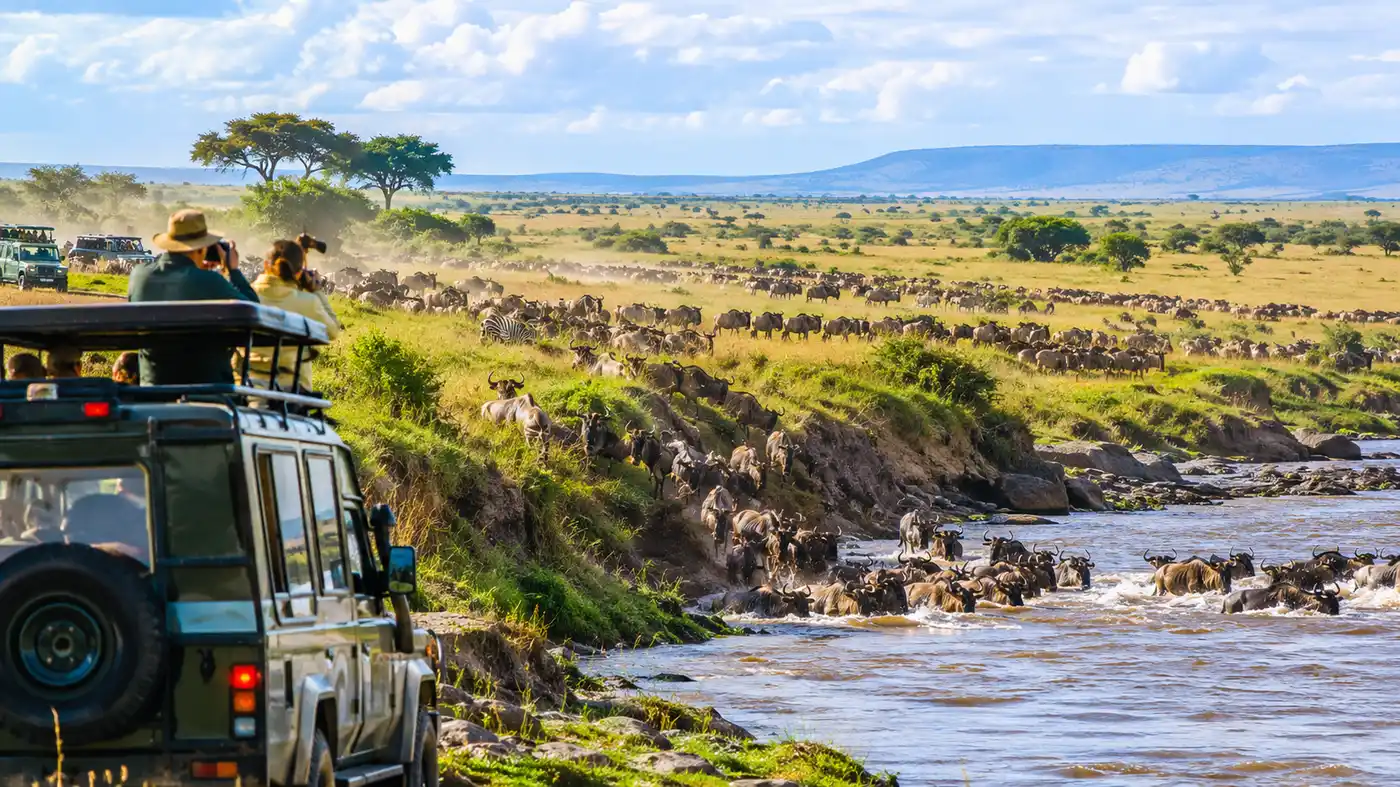
Nothing on earth prepares you for the sheer panic of a river crossing. You might sit in a vehicle for four hours under a blazing midday sun, choking on fine red silt, watching a herd of ten thousand wildebeest pace back and forth on a cliff above the water. They are terrified. They smell the water, but they also smell the dead animals rotting along the bank and see the eyes of prehistoric Nile crocodiles poking out of the current.
The river banks along the scenic paths of the reserve become quiet, tense waiting rooms. Vehicles kill their engines. Nobody speaks above a whisper. Then, one panicked zebra or reckless young bull takes the plunge. In seconds, the entire mass moves. The herd shifts into an unstoppable cascade of hooves, dust, and wild eyes tumbling down the steep embankments into the churning brown water.
The noise is deafening. Wildebeest grunts mix with splashes and the sickening snap of limbs caught on submerged boulders. Crocodiles move in silently, sliding into the downstream pool to take stragglers. It feels violent, chaotic, and completely indifferent to human emotion. Sometimes the crossing lasts forty minutes. Sometimes five animals cross, something spooks the line, and the herd turns around to run back up the bank, leaving you covered in dust with your camera clicking at empty water.
I think the hardest part to stomach is the aftermath. After a massive crossing near the Purungat bridge or Lookout Hill, dozens of drowned carcasses float downstream. Vultures line the sandbanks like grim funeral directors. It is not pretty, but it is the raw fuel that keeps this entire ecosystem alive, feeding fish, birds, lions, and scavengers for months.
Planning a Safari Masai Mara Serengeti Route That Works
A rushed safari is miserable. Trying to pack both the Masai Mara and the Serengeti into five days is a recipe for spending your entire vacation inside a rumbling diesel vehicle with a sore lower back. If you want to do this properly, budget a minimum of eight full days on the ground, excluding your long-haul international flights.
Here are practical rules for building a workable combined itinerary:
- Split your time unevenly: Give four nights to the Serengeti and three nights to the Mara. The Serengeti is enormous and requires more drive time between different habitats, whereas the Mara allows quicker access to dense wildlife pockets.
- Stay in the north during crossing season: If you travel between July and October, do not book lodges in the central Seronera valley. Book mobile camps in the northern Serengeti around Kogatende or the Mara River, placing you twenty minutes from the crossing points.
- Pack soft-sided duffel bags: Bush planes flying between airstrips have strict luggage limits, usually 33 pounds per person, including camera gear. Hard-shell suitcases simply will not fit into the cargo pods under the fuselage.
- Choose camps inside conservancies for Kenya: The public reserve gets absurdly crowded around major crossings. Staying in a conservancy like Mara North or Olare Motorogi gives you quiet, uncrowded night drives and guided walks, with easy daytime access to the main river points.
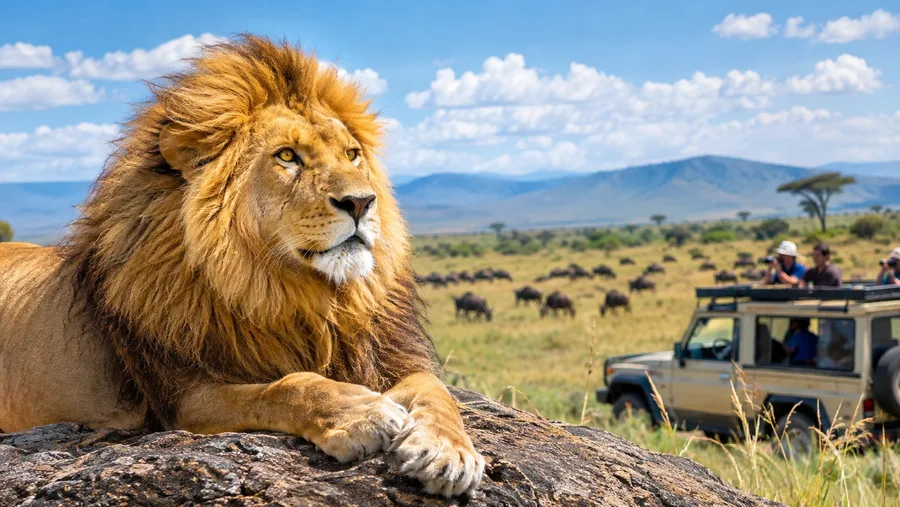
Expect early wake-ups. Most days start at 5:30 in the morning with a cup of hot black tea and a cold biscuit while the grass is still damp. Animals hunt at dawn and dusk, escaping the brutal equatorial heat of midday. By eleven o'clock, lions are usually collapsed under bushwillow shrubs, looking like discarded rugs, and you are heading back to camp for lunch and an afternoon nap.
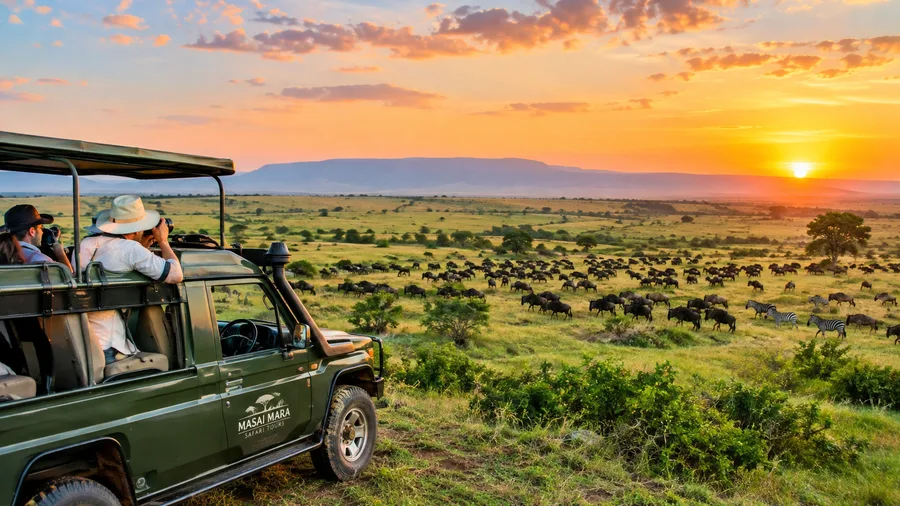
The rhythm takes a couple of days to sink into your bones. But once it does, sitting in an open vehicle while watching thousands of animals file past your window toward the horizon feels entirely normal, and the modern world feels very far away.
Frequently Asked Questions about masai mara and serengeti safari
Can you drive directly between the Masai Mara and Serengeti?
No, you cannot. Even though they share an unfenced border, there is no international immigration facility between the reserves. You must either fly between bush airstrips via an international transit hub like Nairobi or Kilimanjaro, or take an eight-hour overland detour through the Isebania border crossing.
Which park is better for seeing the Great Migration?
Neither is better overall, because the migration depends entirely on the time of year. The Serengeti hosts the herds for about nine months of the year, including the dramatic calving season from January to March. The Masai Mara hosts the herds for three to four months, usually from July to October, offering concentrated viewing and famous river crossings in a more compact area.
How many days do I need for a combined Kenya and Tanzania safari?
You need at least eight to ten days to justify the border crossing and travel logistics. A classic split is three nights in the Masai Mara, three nights in northern Serengeti, and two nights in central Serengeti or the Ngorongoro Crater to break up the journey.
Quick Reference
- Combined ecosystem size: over 12,000 square miles
- Annual migrating herd: 1.5M wildebeest and 250,000 zebras
- Peak river crossing window: late July through October
- Bush plane luggage restriction: strictly 33 lbs in soft duffels
- Border crossing overland: 7 to 8 hours via Isebania
Book your masai mara safari tours experience:
The Bottom Line
A migration journey linking Kenya and Tanzania requires more patience, paperwork, and budget than a standard single-park vacation. You will deal with bumpy gravel roads, multiple airstrip transfers, and dusty waits by the riverbanks. But watching a sea of dark shapes flow across the golden plains, watching them dive into the water with nothing but survival instinct guiding them, makes every mile of transit completely worth it. Book your mobile camps early, keep your schedule flexible enough to chase the rain, and let the herds lead the way.
Read more about masai mara safari tours.